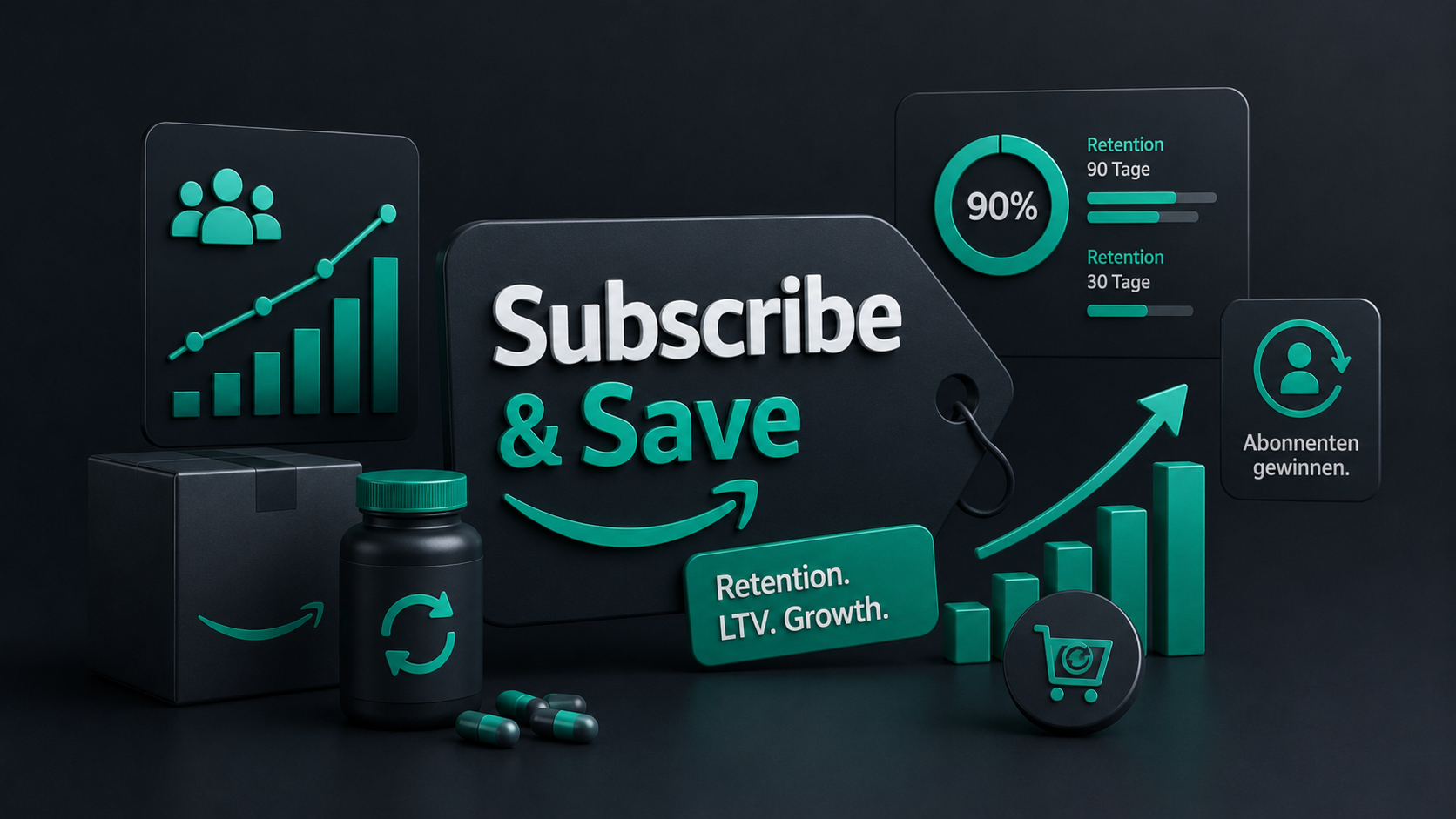
An established Subscribe & Save customer is, in my experience, often worth four to six times as much as a one-time buyer for supplement brands. Yet most brands treat Subscribe & Save like a discount toggle: set it once, forget about it.
The problem usually shows up months later. Subscriber count stalls, ACoS stays stubbornly high, and no one on the team can say whether the campaigns are actually working or just expensive. Amazon now gives you enough data to answer that question, if you know where to look.
In this article, I’ll show you how to turn Subscribe & Save into a real growth lever, which metrics (LTV, AOV, LACoS) actually matter for supplement brands in 2026, and how to run ad campaigns that specifically win subscribers, not just one-time buyers.
Subscribe & Save Is Not a Discount Feature. It’s a Retention Channel
The typical pattern looks like this: a brand sets up Subscribe & Save, picks a discount, and lets the program run. The listing, delivery frequency, and post-purchase messaging stay exactly as they were. Six months later, the enrollment rate is underwhelming, and the response is almost always the same: raise the discount.
The discount is rarely the real problem. A one-time buyer decides to try a product. A subscriber decides to make it part of a routine. That’s a different kind of decision, and it needs ongoing attention, not just a one-time setup click.
What a Subscriber Is Actually Worth: LTV vs. AOV
Across the Amazon accounts I look at, the lifetime value of an established Subscribe & Save customer is often four to six times that of a one-time buyer. The reason is simple: supplements get consumed over months, not purchased once.
That changes your entire advertising math. If a subscriber is worth significantly more than a one-time buyer, you can justify spending significantly more to acquire that first click. Common mistake: brands calibrate their target ACoS as if every click were a single transaction, which means they systematically underbid for the most valuable buyers in the category.
Alongside LTV, Average Order Value (AOV) matters just as much. Clicks in the supplement category are expensive, CPCs run well above the average for other categories. A higher AOV offsets that cost before the first repeat purchase even happens.
The Subscribe & Save Dashboard: Where to Find the Numbers
Amazon overhauled the Subscribe & Save dashboard and it now gives you a lot more depth. You reach it via the hamburger menu, then Growth, then Explore Programs, then Increase Conversion, then Subscribe & Save.
The Key Metrics in the Dashboard
- Subscription count: How many active subscribers you have right now, net. A net change of minus 10 can mean you gained 100 and lost 110.
- LTV by segment: Non-subscriber, lost, growing, and established subscribers, each with its own average value.
- 30-day and 90-day retention: The most important early indicator of the quality of your new subscribers.
- Benchmarking: Amazon compares your brand to similar sellers by category, size, and tenure.
- Funding strategy: How much of the discount you’re covering as the seller, and how that affects sign-ups.
The benchmarking section is often misread. If your Subscribe & Save sales are growing year-over-year well above the category average, but your penetration (share of orders coming from Subscribe & Save) sits below benchmark, that’s rarely a warning sign. Most of the time it just means you’re acquiring new customers faster than your subscriber base can catch up.
The Two Discount Levers Most Brands Confuse
Subscribe & Save has two independent discounts, and the difference between them determines whether the strategy works.
Ongoing Discount
The discount every subscriber gets permanently on every delivery, selectable at 5, 10, 15, or 20 percent. This is where restraint pays off. In many accounts there’s barely a conversion difference between 5 and 10 percent, while a high ongoing discount eats into margin on every single delivery.
First-Order Coupon
The one-time discount that only applies when a customer first enrolls, set up separately as a coupon. This is where it pays to be aggressive, if your LTV justifies it. Important: the two discounts stack. A 25 percent first-order coupon plus a 10 percent ongoing discount adds up to a 35 percent total discount on the first delivery. Account for that deliberately, or your margin will surprise you in month one.
Start conservatively: around 5 percent on the ongoing discount, then test the first-order coupon in steps. Measure 30-day and 90-day retention before pushing the discount any higher.
Why Your Subscriber Count Drops While Profit Looks Fine
This is the mistake I see most often. A brand cuts ad spend or pulls back a coupon to look more profitable in the short term. Daily revenue barely moves, because existing subscribers keep getting shipped automatically. On paper, that looks like a win.
Two to three months later, the real effect shows up: new customer acquisition has dropped, fewer new subscribers are coming in, and subscriber count starts falling. The underlying problem is a blended metric. Your daily revenue mixes at least three different buyer groups: existing Subscribe & Save customers, repeat buyers without a subscription, and new customers.
What to Track Instead
Separate new-to-brand revenue consistently from repeat and Subscribe & Save revenue. The metric that matters here is Customer Acquisition Cost (CAC): ad spend divided by new customers. That’s the only way to see whether a campaign is actually bringing in new buyers or just re-billing existing ones.
Review changes weekly, not daily. Subscribe & Save deliveries fluctuate by day of the week, and day-to-day comparisons distort the picture.
LACoS Instead of ACoS: The Right Metric for Supplement Brands
For supplement brands, standard ACoS is often misleading. A 50 percent ACoS looks disastrous, until you know the customer reorders the product five times a year on average, and the math looks completely different.
That’s where LACoS comes in, lifetime ACoS:
LACoS = ACoS ÷ average purchases per customer per year
Example: a 50 percent ACoS with an average of 5 purchases per customer per year gives you a LACoS of 10 percent. The first click is expensive, but the lifetime math still works.
You’ll find this data in Brand Analytics, specifically under Consumer Behavior Analytics, Repeat Purchase Behavior. Pick as long a time window as possible, ideally quarterly, and the ASIN view. Amazon shows you repeat customer share and repeat orders, but not your LTV directly. You have to back-calculate it: repeat customer share, average order quantity, and product price together give you the number that actually tells you whether a campaign is profitable over time.
For the difference between ACoS and TACoS, and why TACoS is the more important metric to steer by for most brands, I cover that here.
PPC Campaigns That Specifically Win Subscribers
Retargeting: The Underrated Lever
Sponsored Display remarketing is often the most profitable campaign in the whole account for supplement brands. Keep view retargeting (visitors to your listing) strictly separate from purchase retargeting (past buyers), each in its own campaign with a different look-back period.
For purchase retargeting, test several look-back windows in parallel, say 14, 30, and 60 days, based roughly on how long it takes a customer to use up your product. Your first guess is almost never the right one. Amazon Marketing Cloud will show you the actual repurchase cycles for your customers.
Subscribe and Save Lookalikes
Inside Sponsored Display, under Interest & Lifestyle targeting, you’ll find the „Subscribe and Save Lookalikes“ audience. It’s built from shoppers who typically use Subscribe & Save, regardless of brand. For supplement brands focused on subscriber growth, this is one of the most direct audiences currently available.
Ranking Campaigns for Niche Keywords
Supplement brands generally need more single-keyword exact-match ranking campaigns than other categories. The reason: success often comes down to one to three core keywords, and CPCs are high enough that wasted spend gets expensive fast. How to structure these campaigns and calculate bids for them is part of my Amazon Growth consulting.
Increasing AOV: Bundles, Brand Shielding, Cross-Promotion
Three levers that consistently work in practice:
- Bundles: offer multiple units or complementary products together instead of relying on single-unit sales.
- Brand shielding: advertise your own products against each other across Sponsored Products, Sponsored Brands, and Sponsored Display, so „Frequently Bought Together“ gets occupied by your own brand instead of a competitor’s.
- Shoppable Brand Story and A+ carousel: free real estate that looks like advertising but costs nothing. Shoppers barely distinguish between an organic module and a paid ad.
Frequency and Merchandising: The Levers Most Brands Overlook
A 60-day supply delivered monthly creates a stockpile at the customer’s end. Once two or three unopened bottles are sitting in a cupboard, the motivation to skip a delivery or cancel goes up fast. Delivery frequency should match the actual consumption cycle, not Amazon’s default 30-day interval.
At least one of your bullet points should address the subscription option directly. Not just the discount, but the consistency story: results from supplements come from regular use, not a single purchase.
Your 30-Day Action Plan
- Pull your current 30-day and 90-day retention numbers from the Subscribe & Save dashboard. Without this number, you’re optimizing blind.
- Compare your recommended delivery frequency against your product’s actual consumption cycle, and adjust if they don’t match.
- Add a bullet point that explains the subscription option, not just the discount.
- Set up separate Sponsored Display campaigns for view and purchase retargeting, testing at least two look-back windows.
- Calculate your LACoS from Brand Analytics and compare it to your current ACoS target.
Bottom Line
Subscribe & Save isn’t a feature you set up once and leave running. It’s a channel that needs the same ongoing attention as your ad campaigns, with clear metrics and regular adjustment.
Brands that manage both together, campaign structure on one side, retention numbers on the other, end up with noticeably less firefighting in the account and a much more stable TACoS trend over time. That’s the core of my work as an Amazon Ads consultant for supplement and consumable brands: treating campaigns and Subscribe & Save as one system, not two separate jobs.
Frequently Asked Questions About Amazon Subscribe & Save
What is Amazon Subscribe & Save and how does it work for sellers?
Subscribe & Save is Amazon’s subscription program for recurring orders. Buyers get a discount when they opt into automatic deliveries at a set interval. As a seller, you configure the ongoing discount and the optional first-order coupon inside the Subscribe & Save dashboard.
How high should my Subscribe & Save discount be?
Start conservatively on the ongoing discount, usually around 5 percent, since higher tiers rarely bring a proportional conversion lift. The first-order coupon is where a more aggressive number pays off, if your LTV justifies it. Test both levers separately and measure 30-day and 90-day retention.
What’s the difference between ACoS and LACoS?
ACoS looks at a single transaction: ad spend divided by ad revenue. LACoS (lifetime ACoS) factors in the average number of repeat purchases per customer, showing whether a campaign that looks expensive on the surface is still profitable over the customer’s lifetime.
Why is my subscriber count dropping while profit is going up?
Usually because ad spend or coupons got cut. Existing subscribers keep getting shipped, so daily revenue barely moves. But new customer acquisition drops, and that only shows up as a falling subscriber count two to three months later.
How can I specifically target likely Subscribe & Save customers with ads?
Inside Sponsored Display, under Interest & Lifestyle targeting, there’s a „Subscribe and Save Lookalikes“ audience. Purchase retargeting on past buyers of your own product, combined with custom look-back periods, also works reliably.
How often should delivery frequency be set for a supplement?
Frequency should match the actual consumption cycle. A 60-day supply fits a bimonthly delivery better than a monthly one, otherwise you create a stockpile at the customer’s end that encourages cancellations.
When does Subscribe & Save make sense for my brand?
Whenever your product gets consumed and reordered regularly, typically supplements, skincare, or other consumables. The higher the natural reorder rate, the bigger the lever on LTV and TACoS over time.
Brauchst du Hilfe mit deinem Amazon-Kanal?
Lass uns in 15 Minuten auf dein Setup schauen und herausfinden, wo die größten Hebel liegen.
Kostenloses Erstgespräch buchen →