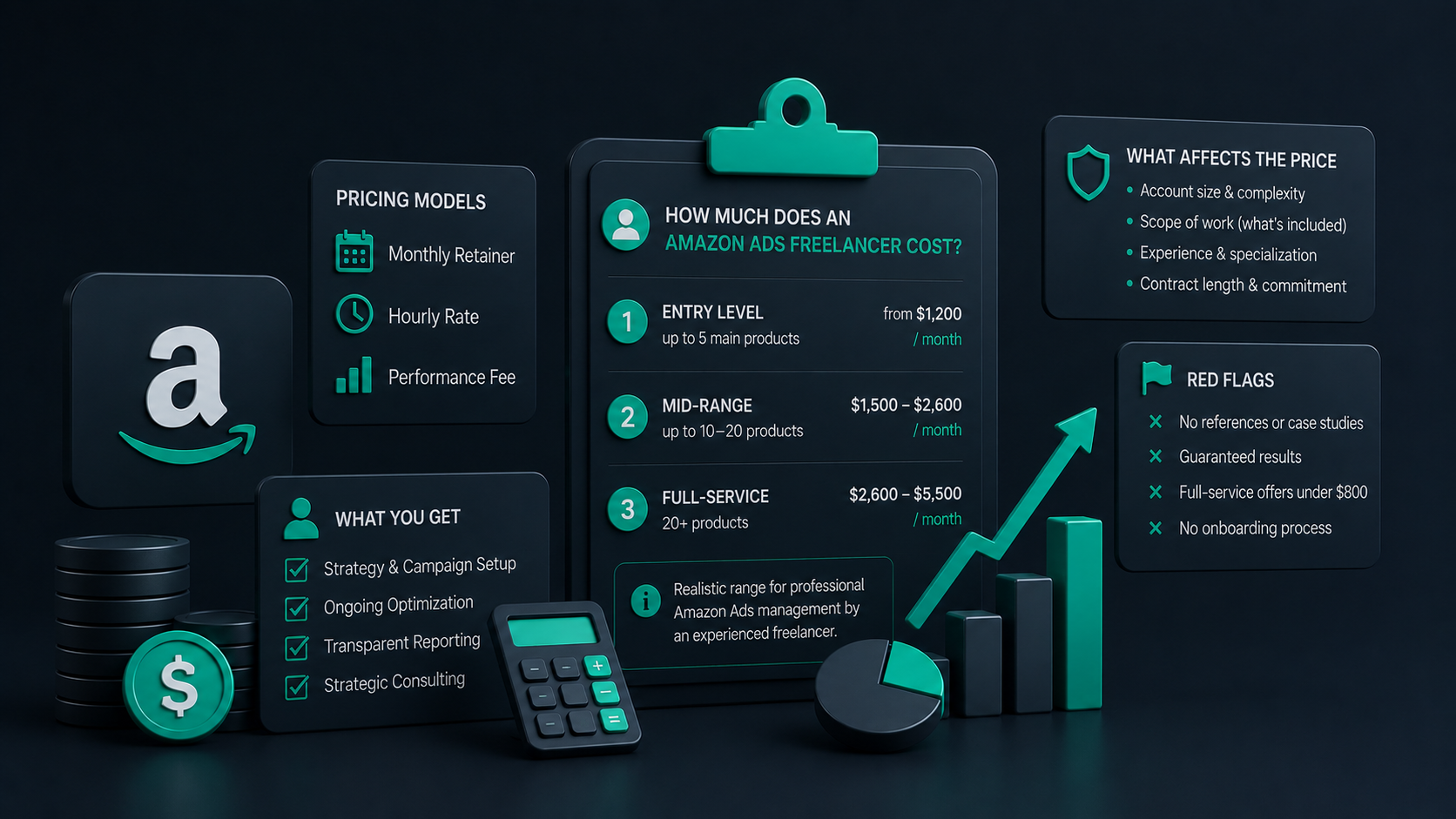
Amazon Ads cost whatever you pay per click, multiplied by the clicks you buy. On top comes management: a specialized freelancer sits at €1,200 to €5,500 per month, an agency depending on the model above that or as a percentage of ad spend.
Most guides to Amazon advertising costs mix the two together. That creates the wrong expectations. If you only compare the management fee, you overlook the ad budget. If you only know the CPC, you underestimate what good management costs.
In this article I separate the cost blocks, work through a budget and show you how to recognize a fair offer. In many Amazon accounts I take over, exactly this separation is missing.
- Amazon Ads cost at a glance: three cost blocks
- What a click costs: CPC and the auction
- Calculating your ad budget: a worked example
- What an Amazon Ads freelancer costs
- Amazon agency pricing: models and comparison
- Three pricing models compared
- What drives the price
- What you get for your money
- Hidden costs and contract details
- Red flags when comparing prices
- What to prepare before your first call
- Summary
- Frequently asked questions about Amazon Ads cost
Amazon Ads cost at a glance: three cost blocks
When someone asks what Amazon Ads cost, they usually mean three different things:
| Cost block | Who gets the money | Order of magnitude |
|---|---|---|
| Ad budget (clicks) | Amazon | Freely selectable, depends on revenue goal and margin |
| Management | Freelancer or agency | Freelancer from €1,200 per month, agencies depending on the model |
| Content and tools | Service providers, software vendors | Listings and A+ Content usually one-off per product, tools monthly |
For Sponsored Products and Sponsored Brands, Amazon charges no base fee. You pay when someone clicks.
What I see most often: the management fee gets negotiated, but the ad budget is not planned properly. Yet the budget, together with your margin, decides whether ads pay off at all.
What a click costs: CPC and the auction
Sponsored Products and Sponsored Brands run on an auction. You set a maximum bid and pay at most that amount per click, in practice often less. What a click actually costs depends on category, competition, placement and season.
As a rough guide to Amazon PPC cost per click:
| Category type | Examples | Rough CPC range |
|---|---|---|
| Low | Books, household, garden | approx. €0.20 to €0.50 |
| Medium | Toys, pets, kitchen, sports | approx. €0.50 to €1.50 |
| High | Supplements, beauty, electronics, baby | from approx. €1.50 |
These are market values for orientation, not figures from Amazon. In your account the CPC can differ significantly, for example on brand keywords (usually cheaper) or around Prime Day (usually much more expensive).
A CPC alone says little. What matters is what an order costs. Worked example: at €0.80 per click and a 10 percent conversion rate, an order costs you €8 in ad spend. If you sell the product for €30, your ACoS is around 27 percent.
Calculating your ad budget: a worked example
I never start with the budget, I start with the goal. A simple example:
- Total Amazon revenue: €40,000 per month (organic and ads combined)
- Target TACoS: 10 percent, so €4,000 ad budget per month
- ACoS: at 25 percent, the €4,000 generate about €16,000 in ad revenue, which is 40 percent of your total revenue
Your margin sets the ceiling. If 30 percent margin remains after Amazon fees, shipping and cost of goods, your break-even ACoS is 30 percent. Anything above that loses money on every ad order, unless you are deliberately building rank.
Rules of thumb from my practice, not a law: for established products a sensible TACoS is often 5 to 10 percent, during a launch 10 to 20 percent and time-limited. How to tell ACoS and TACoS apart is covered in ACoS vs. TACoS: which metric matters. How a launch budget is built is shown in the 90-day plan for an Amazon product launch.
What an Amazon Ads freelancer costs
A realistic overview, structured by account size and scope:
| Tier | Scope | Price per month |
|---|---|---|
| Entry level | up to 5 main products, ongoing ads management | from €1,200 |
| Mid-range | 10 to 20 products, incl. strategy and reporting | €1,500 to €2,600 |
| Full service | 20+ products, incl. product launches | €2,600 to €5,500 |
These figures refer to specialized Amazon freelancers with proven experience, not to generalists or platform freelancers without an Amazon focus. Anyone offering “everything” for €400 to €600 a month usually manages 30 other accounts at the same time.
With me there is no separate setup fee. The account setup is included in the monthly management.
Amazon agency pricing: models and comparison
Agencies usually charge a monthly retainer, a percentage of ad spend, or a mix of both. For a comparable scope, a specialized freelancer is usually 20 to 40 percent below agency management, because the agency finances team and overhead. Some agencies add setup fees and minimum terms.
For your specific offer, the scope matters, not the number. Always compare what is included in the price: campaigns, reporting, strategy, listing adjustments, launches.
The percentage model carries a conflict of interest: the agency earns more when you spend more, not when you become more profitable. An example at 15 percent: on a €4,000 ad budget that is a €600 fee, on €8,000 already €1,200, regardless of whether ACoS drops. If you choose a percentage model, combine it with a target ACoS or target TACoS in the contract.
Freelancer or agency: the comparison
| Criterion | Freelancer | Agency |
|---|---|---|
| Price level | usually lower, no agency overhead | often higher, team and overhead are priced in |
| Point of contact | one person who knows your account | account manager, changes are possible |
| Capacity | limited by one person | more capacity and broader specialties |
| Contract | often more flexible | often a minimum term |
| Best for | focused accounts with clear goals | large catalogs, many marketplaces, high content needs |
Both can work. For large catalogs across many marketplaces with high content needs, an agency is often the better choice. For a focused account with clear goals, an experienced freelancer is usually more economical.
Three pricing models compared
Monthly retainer
The most common model. You pay a fixed amount for a defined scope. Advantage: planning security. Disadvantage: if the provider does not stick to the scope, quality drops quickly.
Hourly rate
Flexible, but hard to budget. Suitable for one-off projects such as a campaign audit or an account rebuild. Less recommended for ongoing management, because the incentive for efficiency is missing.
Performance fee
A share of the generated ad revenue or a bonus when goals are met. Sounds attractive but has a catch: anyone optimizing purely for revenue neglects profitability. ACoS and TACoS can rise while revenue grows. Without a solid base retainer, this model should be handled with caution.
What drives the price
- Account size and complexity. An account with 10 ASINs and a €2,000 monthly budget is a different job than one with 200 products, Sponsored Display and DSP. More campaigns mean more optimization work.
- Scope of service. Pure campaign management is cheaper than a full package with listing optimization, reporting and strategic advice. Clarify up front exactly what is included in the price.
- Experience and specialization. Someone who has done nothing but Amazon PPC for years usually works better than a generalist who also runs Facebook Ads and Google on the side.
- Term and commitment. Short-term projects cost more per month than long-term collaborations.
What you get for your money
A professional provider delivers more than clicks and budget distribution. The standard scope should include:
- Campaign structure and setup: clean separation by match type, goal and product group. No bloated auto campaigns without a strategy.
- Regular optimization: at least weekly bid adjustments, negative keyword maintenance, detection of wasted spend. Anyone who optimizes only monthly wastes budget. How part of this can be automated is covered in the article on rule-based bid management.
- Transparent reporting: you get not just numbers but understand why ACoS or TACoS changed.
- Strategic context: good PPC does not stop at campaigns. Listing quality, pricing and seasonality belong in the advice. What is currently changing in Amazon PPC, I explain in Amazon PPC 2026.
Hidden costs and contract details
Besides the fee, details in the offer decide what you end up paying. I check these points in every offer:
- Setup fee: Is the account build charged separately, and what does it include? With me there is no separate setup fee, the build is included in the monthly management.
- Tools: Who pays for software for keyword research, reporting or bid automation?
- Term and cancellation: minimum term, notice period and what happens on early termination.
- Account access: The ad account and all campaigns must belong to you. The provider works through access rights, not through their own account.
- Extras: Are reporting calls, listing adjustments or creatives included, or billed separately?
Red flags when comparing prices
Not every cheap offer is bad, but the following points should make you skeptical:
- No clear reference list. Anyone achieving good results can prove it. No case studies, no numbers, no answers to concrete questions about the account? Keep looking.
- Guaranteed results. “We guarantee a 20 percent ACoS reduction in 30 days” is something nobody can credibly promise. Algorithms, competition and seasonality are not constants.
- Offers under €800 per month for “full service”. At that price you get either pure automation without strategic judgment or someone managing 50 other accounts at the same time.
- No onboarding process. An experienced provider first asks about goals, margin, seasonality and competitors. Anyone who starts right away is optimizing blind.
What to prepare before your first call
Have these three things ready before you reach out:
- Your monthly ad budget and whether it is fixed or flexible.
- Your target TACoS or target ACoS, or at least your product margin, so a target can be derived.
- The time frame: one-off, short-term or long-term. This directly affects model and price.
If you want to know where your account stands first, a Marketplace Audit is the fastest way to a reliable baseline. And if it is about more than ads, you will find my approach under Amazon Growth Consulting.
Summary
- Amazon Ads cost consist of ad budget, management and content/tools. Plan for all three.
- With Sponsored Ads you pay per click, there is no base fee.
- Calculate the budget from target TACoS and break-even ACoS, not from gut feeling.
- A specialized freelancer usually costs €1,200 to €5,500 per month.
- Agencies charge a retainer, a percentage of ad spend or a hybrid. Percentage models need an efficiency target in the contract.
- Watch for setup fee, minimum term, account access and tools in the offer.
- Price alone is not a quality indicator, clear scope and proven experience are.
Frequently asked questions about Amazon Ads cost
How much do Amazon Ads cost per month?
There is no fixed base fee, you set the budget yourself. It usually becomes economically manageable from around €1,500 to €2,000 ad budget per month, because that generates enough data to optimize.
How much does a click on Amazon cost?
It depends heavily on the category. As a rough guide, low-cost categories sit at about €0.20 to €0.50, medium ones at €0.50 to €1.50, and competitive categories such as supplements or beauty from about €1.50 per click.
What percentage of revenue should I spend on Amazon Ads?
As a rule of thumb, 5 to 10 percent TACoS for established products and 10 to 20 percent during a launch. Your margin sets the ceiling: your break-even ACoS should not be exceeded, unless you are deliberately building rank.
How much does an Amazon PPC agency cost per month?
It depends on the model and scope. Agencies charge a retainer, a percentage of ad spend or a hybrid. A specialized freelancer at €1,200 to €5,500 per month is usually 20 to 40 percent below that for a comparable scope. Check setup fee, minimum term and what is included in the price.
Is a freelancer cheaper than an agency?
Usually yes, because you do not finance agency overhead. An experienced freelancer with comparable specialization is typically 20 to 40 percent below agency management with a similar scope. For very large catalogs across many marketplaces, an agency can still be the better choice because it has more capacity.
What’s a fair hourly rate for Amazon Ads?
Experienced Amazon PPC specialists typically charge between €80 and €150 per hour. Significantly less is a warning sign for missing specialization, significantly more should be justified with concrete results.
Is a freelancer worth it for a small account?
From about 5 main products and an ad budget of €1,500 to €2,000 per month, professional management usually becomes economically sensible. Below that, a one-off setup project is often the better choice than ongoing management.
At what revenue does ongoing management pay off?
Work backwards: fee plus ad budget must stand in a sensible relation to your margin. As a rough rule of thumb, ongoing management usually becomes economical from about €20,000 Amazon revenue per month.
What’s the difference between a monthly retainer and a performance fee?
With a monthly retainer you pay a fixed amount regardless of the outcome. With a performance fee, part of the compensation depends on revenue or target values. That can create incentives that do not always align with profitability.
How long does it take to see first results?
First optimization effects usually show after 4 to 6 weeks. For strategic improvements such as campaign structure or ranking effects, expect around 3 months.
Should I hire a freelancer or a full-time in-house person?
For accounts under 20 main products, a freelancer is usually more economical, because you only pay for actual working time instead of a full position. For very large catalogs, a combination of in-house and external advice can make sense.
How do I spot a freelancer who is managing too many accounts?
If bid adjustments happen only monthly instead of weekly, reporting feels generic, or there is no time for a thorough onboarding conversation.
Brauchst du Hilfe mit deinem Amazon-Kanal?
Lass uns in 15 Minuten auf dein Setup schauen und herausfinden, wo die größten Hebel liegen.
Kostenloses Erstgespräch buchen →